



Common Reasons Retaining Walls Fail
Inadequate Drainage & Retaining Wall Failures
Common Causes of Drainage Issues
A properly installed wall must have proper drainage systems in place. This isn’t optional; it’s essential for long-term stability.
Common solutions include:
- Weep Holes: These are small holes at the base of the wall that allow water to escape. They’re a simple but effective way to relieve hydrostatic pressure.
- Crushed Stone Backfill: Using gravel or crushed stone as backfill material directly behind the wall creates a vertical drainage channel. Water trickles down through the gravel instead of saturating the soil.
- French Drains: A perforated pipe laid in gravel at the base of the wall collects and channels surface water away from the structure.
Poor Wall Design & Construction Issues
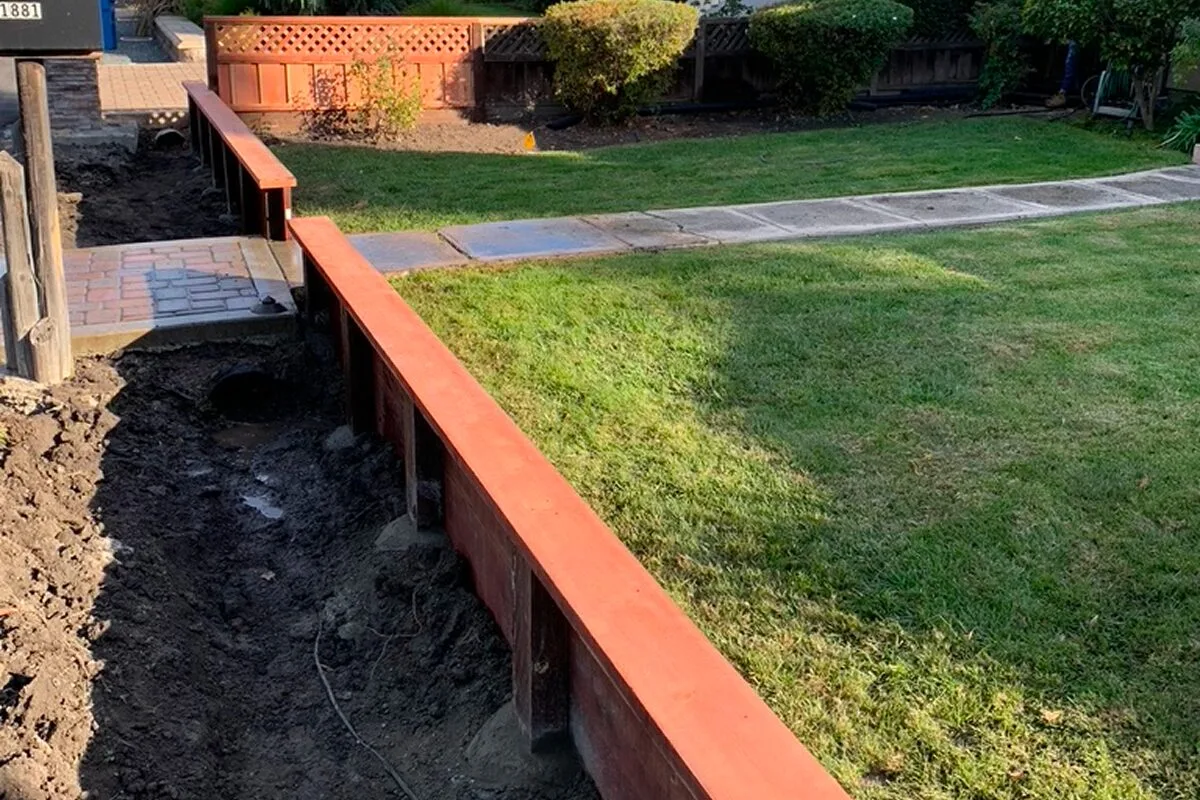
A retaining wall is a complex structure that needs to balance the earth pressure from behind with its own strength. A flawed wall design is a recipe for disaster. This is where a professional engineer or an experienced construction team makes all the difference.
One of the most common design flaws is building a wall that’s too weak for its height. As wall height increases, the soil pressure it needs to resist increases exponentially, not linearly. A 4-foot wall has to withstand significantly more than double the pressure of a 2-foot wall. This is why taller walls (often anything over 3-4 feet) require engineered plans.
Other construction mistakes that lead to failure include:
Weak Foundation
A shallow or poorly compacted foundation can’t support the weight of the wall and the soil, leading to settling, cracking, and failure.
Wrong Backfill Material
Using heavy clay soil as backfill material is a huge mistake. Clay holds water, increasing hydrostatic pressure and putting extra strain on the wall structure. A quality gravel backfill is crucial.
No Batter
Most retaining walls should have a slight backward lean, or “batter.” This helps the wall use gravity to its advantage to resist soil pressure. A perfectly vertical wall is actually at a disadvantage.
These aren’t details you can afford to get wrong. The team at FCR Fence & Deck understands the physics behind these structures and builds them to last.
Surcharge Loads Behind the Wall
The pressure on your retaining wall doesn’t just come from the soil directly behind it. Any extra weight on the ground above and behind the wall is called a “surcharge load,” and it can dramatically increase the earth’s pressure.
What counts as a surcharge load?
- A driveway or parking area
- A steep slope rising above the wall
- A patio or another structure
- Even large trees or landscaping features
A surprising number of retaining walls fail because these heavy loads weren’t accounted for in the original wall design. For example, if a wall was designed to only hold back a flat patch of lawn, and a few years later you build a patio on top of that slope, you’ve just added thousands of pounds of pressure that the wall was never meant to handle.
Other Factors That Lead to Retaining Wall Failures
Poor Soils
Using Low-Quality Materials
Trying to save money with cheap concrete blocks or untreated wood is a surefire way to shorten your wall’s lifespan. Quality materials for fences and retaining walls withstand weather and pressure. For most retaining walls, using the right materials is just as important as the right design.
Lack of Maintenance
While well-built retaining walls are low-maintenance, they aren’t “no-maintenance.” It’s important to periodically check that weep holes are clear of debris and that there are no signs of soil erosion around the wall. Proactive maintenance can prevent small issues from becoming a complete failure.
Conclusion
Retaining wall failures don’t happen by accident: they happen because something critical was overlooked. These problems all have one thing in common: they could have been prevented with the right expertise from the start.
A retaining wall isn’t just another backyard feature. It’s an engineered system holding back tons of soil, and when it’s built correctly, it works silently and reliably for decades. When it’s not? You’re left with cracks, leaning walls, sinkholes, and costly repairs that could’ve been avoided.
Strengthen Your Property With a Professionally Built Retaining Wall
If you want a retaining wall that stays solid year after year, you need more than guesswork and a pile of blocks. You need a team that knows how to engineer drainage, select the right materials, and build a structure capable of handling the pressure behind it. That’s where FCR Fence & Deck comes in.
Our team doesn’t cut corners. From fence & gate installation to composite decking installation, we cover everything. We assess your soil conditions, slope, water flow, load requirements, and long-term needs before a single block is set in place. Contact FCR Fence & Deck today to schedule a consultation.