




How to Calculate a Deck Size
To calculate a deck size, measure the deck length and deck width, then multiply them to get the total square footage. A 20 ft by 16 ft deck equals 320 sq. ft. That number drives how much decking you buy, how many boards you need, and what the deck project will cost.
The steps covered in this guide:
- Choosing the right deck size
- Checking local rules
- Calculating deck square footage
- Calculating board square footage
- Finding the number of boards required
- Adjusting for joist spacing and board layout
We prepared this guide for homeowners planning a new deck who want accurate material costs before starting. Accurate calculations prevent ordering too few boards mid-build or paying for lumber you don’t use.
Choosing the Right Deck Size
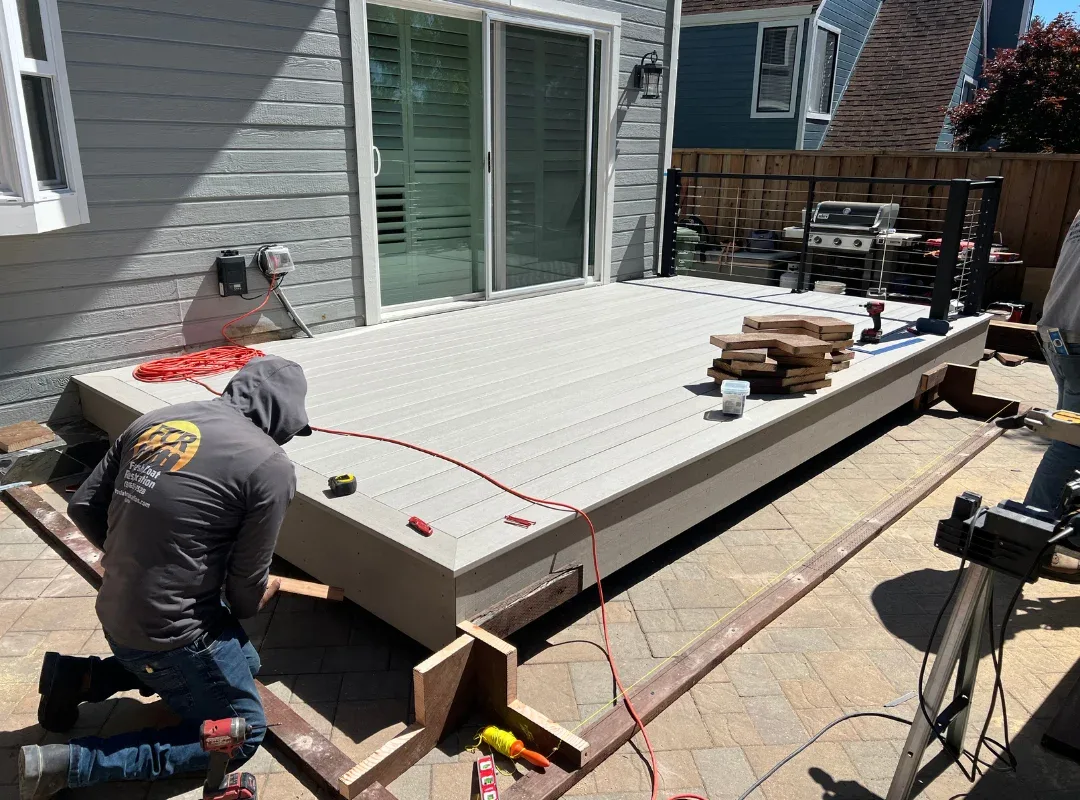
Deck size starts with its intended use. The average deck ranges between 300 and 400 square feet. These planning tips cover the main factors that decide the size:
- Furniture and clearance: Allow at least 3 feet of clearance around furniture for comfortable movement.
- Zones: Plan distinct zones on a larger deck for dining, lounging, and cooking.
- Traffic flow: Keep a clear path between the house door, the stairs, and each zone.
- Future needs: Leave room for a hot tub, a larger table, an outdoor kitchen, or deck lighting you may add later.
- Proportion: Match the deck to the house. A massive deck can overwhelm the architecture of a small house and create visual imbalance.
As a first step, measure the available ground space for the footprint. Then mark the outline with stakes and painter’s tape to see the layout before construction starts.
Identify how the deck will be supported before you set its dimensions. The position of the ledger, beams, and posts affects the final length and width.
Check Local Rules Before Your Deck Build
Check with your local building authority for property line rules and lot coverage limits before you finalize the deck size:
- Local municipal codes set setbacks for structures near property lines.
- Local zoning laws may limit the maximum lot coverage.
- Local building codes provide prescriptive tables for joist spans and beam sizing.
- Decks beyond a certain size or height may require engineering approval.
In California, a deck needs a permit unless it is 200 square feet or less, no more than 30 inches above grade, freestanding, and not serving a required exit door.
How to Calculate Deck Square Footage
To calculate the deck’s square footage, multiply the length by the width.
Measure Deck Length & Width
Use a tape measure to record the deck length along the house and the deck width out from the house, in feet. Multiply the length and width for the deck area.
Example: 20 ft × 16 ft = 320 sq. ft.
Add Multiple Platforms & Stairs
For a multi-level deck, calculate each platform separately, then add the areas for the total area. Include stairs in the total area, too. For example, a 320 sq. ft. main deck plus a 10 ft × 8 ft lower platform equals 400 sq. ft.
How to Calculate Board Square Footage
Board square footage is the surface area one board covers. Multiply the board length by the board width, then divide by 144 to convert square inches to square feet.
Board Size
Deck boards come in common sizes, including 5/4×6 and 2×6. Deck board widths typically range from 4 to 8 inches. Composite decking boards are usually about 5.4 inches wide.
Board Width & Board Length
Common decking board lengths range from 8 to 20 feet. A 16-foot board about 5.4 inches wide covers approximately 7.2 square feet (192 inches × 5.4 inches ÷ 144). Choose board lengths that match your deck length to minimize waste. Standard lumber dimensions reduce cutting labor with a circular saw and leave fewer offcuts.
Board Spacing
Deck boards need a 1/8 to 1/4-inch gap between them for drainage and expansion. The number of gaps equals the number of boards minus one. Add the gap to the board width to find how much deck width each board covers.
Example: A 16-foot-wide deck is 192 inches. With 5.4-inch composite boards and 1/4-inch gaps, each board covers 5.65 inches. 192 ÷ 5.65 = 34 boards with 33 gaps between them.
Calculating the Deck Boards Required
To find how many boards you need, divide the deck’s square footage by the board’s square footage.
Example: 320 sq. ft. ÷ 7.2 sq. ft. = 44.4, rounded up to 45 boards.
Then add 10% to 15% extra boards for waste and offcuts. For example, 45 boards plus 10% to 15% equals 50 to 52 decking boards. Complex layouts with diagonal patterns, angles, or borders may require a 15% to 20% waste allowance.
Calculate fascia boards separately. Measure the deck’s perimeter and divide by the board length to determine the fascia board count. Count stair treads separately as well.
Composite Decking & Joist Spacing
Joist spacing affects how the boards are laid and how many joists support the surface:
- Most wood and composite decking is laid over joists 16 inches on center.
- Diagonal 5/4 and composite decking need joists 12 inches on center.
- For safety, composite decking must follow the manufacturer’s span rating.
Material choice also affects cost per square foot. Compare decking materials using the same board count so the planks and quotes match.
Plan Your Deck with FCR Fence & Deck
FCR Fence & Deck is a licensed, bonded, and insured contractor (Lic. #962764) serving Martinez and the East Bay. Our team measures your yard, sizes the deck to your house and lot, and builds wood and composite decks with code-compliant framing.
Frequently Asked Questions
1. Is a 12x24 deck a good size?
Yes. A 12×24 deck provides 288 square feet, close to the 300- to 400-square-foot average. It fits a dining area and a lounge area with 3 feet of clearance.
2. Should a deck use 2x6 or 2x8?
Use 2×8 joists for most decks. At 16 inches on center, a Douglas fir-larch 2×8 spans 11 feet 1 inch, while a 2×6 spans only 8 feet 8 inches under IRC Table R507.6.
3. How far can a 2x8 deck span without support?
At 16-inch spacing, a Douglas fir-larch 2×8 spans 11 feet 1 inch. At 12-inch spacing, it reaches 12 feet 6 inches.
4. What are common deck framing mistakes?
Common mistakes include exceeding joist spans, nailing the ledger instead of bolting it, omitting flashing, using undersized beams, and omitting lateral load connectors at the deck-to-house connection.
5. What happens if my deck joists are too far apart?
Deck boards bounce, sag, and can crack between supports over time. The deck may fail inspection, and composite decking warranties can be voided when joist spacing exceeds the manufacturer’s limits.